New Vial, Different Strength? You Could Draw Double by Mistake
Switching GLP-1 vial concentrations changes the units you draw, not your dose. How to read mg/mL, recalculate safely, and check before you inject.
✓Medically reviewed by Farnia Bahari, PharmD
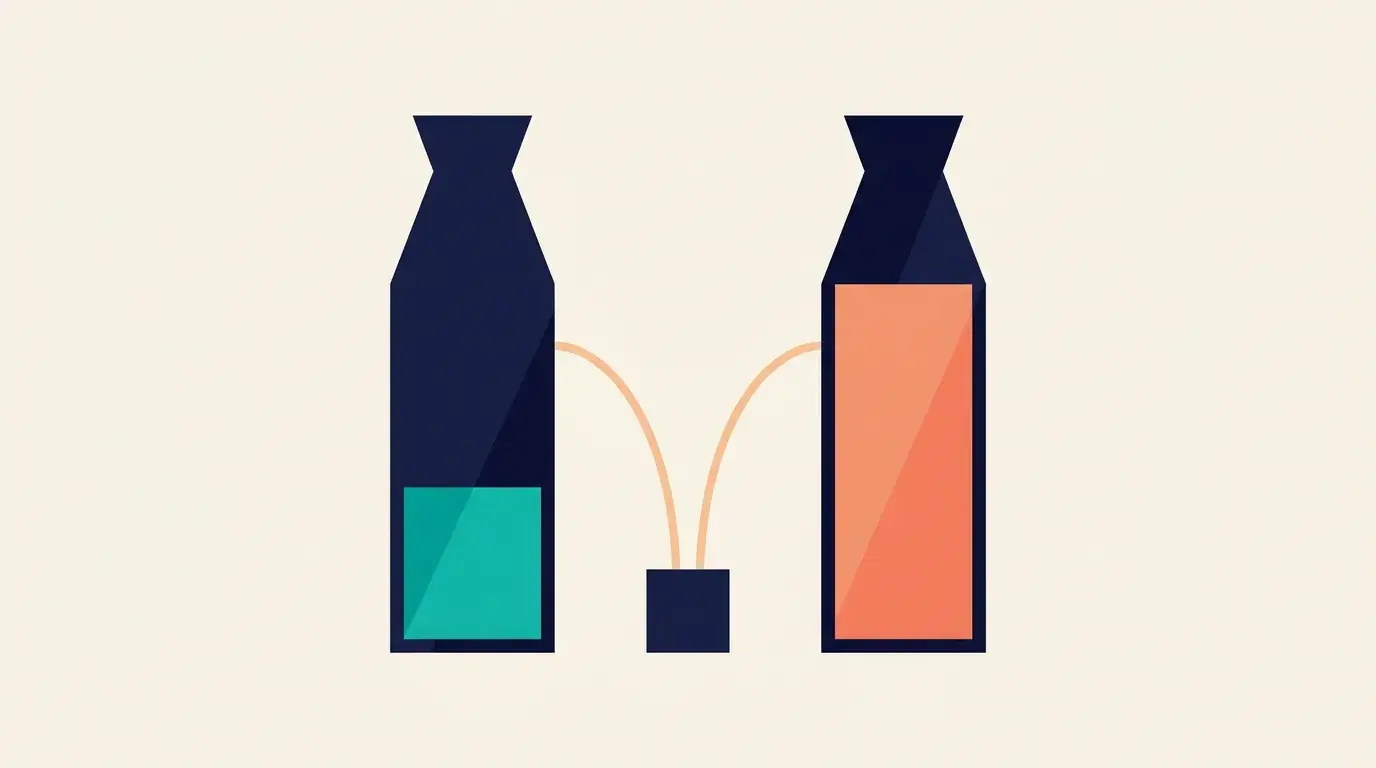
If your new vial has a different concentration, your prescribed dose in milligrams has not changed — but the number of units you draw has. Divide your dose in mg by the new vial's mg/mL, then multiply by 100 for a U-100 syringe. Never reuse the unit number from your old vial. Read the mg/mL printed on the label, not the total milligrams, before the first draw from any new bottle. (Source: standard concentration arithmetic; verify your own vial against its label and your pharmacy's instructions.)
The one sentence that matters
The dose stays the same. The units change.
Your prescriber set a dose in milligrams. That's the medical decision. Units are just a measurement of volume on your syringe — a way of counting how much liquid contains that many milligrams. Change the concentration and the same milligrams occupy a different volume.
Here's what that looks like when it goes wrong, and it's the most common serious dosing error in compounded GLP-1 use:
You've been drawing 10 units from a 2.5 mg/mL vial. That's 0.25 mg — your prescribed dose.Your new vial is 5 mg/mL. You draw 10 units out of habit.You've just taken 0.5 mg — double your dose.
Nothing about the medication changed. Nothing about your prescription changed. The only thing that changed was a number on a label you didn't read, and the result is a doubled dose.
The correct draw from that 5 mg/mL vial is 5 units.
Reading the vial label: mg vs mg/mL
Two numbers on the label look similar and mean completely different things.
Total mg is how much drug is in the whole vial. A "10 mg vial" contains 10 milligrams of medication in total.
mg/mL is the concentration — how much drug is in each millilitre. This is the number you need.
They're only the same if the vial happens to contain exactly 1 mL, which many don't.
If your label only shows total mg, you can derive the concentration yourself — total mg ÷ total mL = mg/mL — but only if the volume is also printed. If you can't find both numbers, call the pharmacy and ask for the concentration. Don't estimate, and don't assume it matches your last vial.
A "10 mg vial" tells you nothing about what to draw until you know whether that 10 mg sits in 1 mL, 2 mL or 5 mL. Those three vials require completely different draws for an identical prescribed dose.
Recalculating: the walkthrough
Four steps, two minutes, every time you open a new vial.
Step 1 — Confirm your dose in milligrams. From your prescription, not from memory of how many units you usually draw. This is the number that hasn't changed and the only fixed point in the calculation.
Step 2 — Read the new vial's concentration. Off the label in front of you. Not last month's label, not what the pharmacy said on the phone in March.
Step 3 — Calculate.
Units = (dose in mg ÷ concentration in mg/mL) × 100
Step 4 — Cross-check before you draw. Run the number backwards: what does that many units equal in mg at this concentration? If it doesn't match your prescribed dose, stop.
Worked examples
Prescribed dose: 0.5 mg of semaglutide.
Vial concentration | Calculation | Units to draw |
|---|---|---|
2.5 mg/mL | (0.5 ÷ 2.5) × 100 | 20 units |
5 mg/mL | (0.5 ÷ 5) × 100 | 10 units |
10 mg/mL | (0.5 ÷ 10) × 100 | 5 units |
One prescription. Three vials. Three completely different draws — and a fourfold difference between the top and bottom rows.
Tiro's vial transition calculator does this in one step: enter your dose and the new concentration and it returns the units. The reverse dose calculator does step 4 — enter units and concentration, get milligrams.
The pre-injection check
Screenshot this. It takes under two minutes and it is the whole point of this article.
### Before your first draw from any new vial1. New vial? Stop. Don't draw on autopilot. The habit is the hazard.2. Read the mg/mL on the label. The actual label, in your hand, right now.3. Confirm your prescribed dose in mg. From your prescription.4. Recalculate the units. (mg ÷ mg/mL) × 100.5. Reverse-check, then draw. Units × mg/mL ÷ 100 should equal your dose.
One extra trick worth adopting: write the correct unit number on a piece of tape and stick it to the new vial. Then the number you need is physically attached to the bottle it applies to, and it's impossible to carry the old number across. It's a small thing that removes the entire failure mode.
Switching between compounded and branded
This is when concentration errors cluster, because almost everything changes at once.
Branded Zepbound vials are the simple case. Every single-dose vial contains 0.5 mL — 50 units on a U-100 syringe — at every strength. There's no calculation. If you're moving to branded vials, you can put the arithmetic down. See Zepbound vials.
Compounded vials are the variable case. Concentrations differ between pharmacies, between batches, and sometimes between refills from the same pharmacy. Multi-dose presentations with preservatives are common, which is a different sterility situation from single-dose vials.
Moving to pens removes syringes entirely — the dose is preset or dialled, not measured. Different skill, different error modes. See pen clicks.
On the regulatory side: compounded semaglutide and tirzepatide are not FDA-approved products, and compounding of these molecules has been subject to changing restrictions since the shortages ended.
Editor note: state the current FDA position on compounded semaglutide and tirzepatide as of publication, with a citation, and set a review reminder. This paragraph stales faster than anything else on the page.
If your titration schedule is continuing across the switch, the dose titration planner keeps the ladder straight, and the full GLP-1 dose chart shows where each brand's steps sit.
If you think you mis-dosed
Do not take more to "correct" it, and do not skip ahead to compensate.
- Write down exactly what happened — the units you drew, the vial concentration, the time. Precision here is what lets a clinician help you.
- Contact your prescriber or pharmacist. Today, not at your next appointment.
- If you feel unwell — persistent vomiting, severe abdominal pain, signs of dehydration, or anything frightening — seek urgent medical care. Take the vial with you.
An accidental double dose most commonly produces amplified GI side effects rather than an emergency, but that is not a reason to handle it alone. Let a clinician make that assessment.
And if it turns out you've been under-dosing for weeks — the mirror-image error — that's worth flagging too. It explains a stall that would otherwise look like a plateau. See the plateau playbook.
Frequently asked questions
My new vial is a different strength — do I take a different dose? No. Your prescribed dose in milligrams is unchanged. Only the units you draw change, because the concentration is different.
How do I work out the new units? Units = (your dose in mg ÷ the vial's mg/mL) × 100 on a U-100 syringe.
What's the difference between mg and mg/mL on a vial? mg is the total drug in the vial; mg/mL is how concentrated it is. You need mg/mL to calculate units — the total alone isn't enough.
Why did my pharmacy change my concentration? Batch, supply and formulation changes are routine with compounded products. Treat every new vial as a fresh calculation.
Can I use my old unit number if it's the same medication? No. Same medication, different concentration means a different volume for the same dose. Recalculate every time.
I think I drew the wrong amount — what now? Don't re-dose to compensate. Write down exactly what you drew and when, and contact your prescriber or pharmacist. Seek urgent care if you feel unwell.
Your history should survive a vial change
Tiro records the concentration alongside every dose you log, so when the vial changes your record still adds up — and you can see at a glance what you were actually taking three months ago.
Recalculate for a new vial → · Check units back to mg → · All Tiro GLP-1 tools →
Tiro is a tracker and companion app. It is not a treatment, does not diagnose, and does not replace your prescriber.
Track it in Tiro
Stop reading about it. Start tracking it.
Tiro turns the advice in this article into a tracked routine — your dose schedule, protein floor, symptoms, and body composition, all in one place.