Retatrutide Dose Calculator: The Reconstitution Maths, Explained Honestly
How retatrutide reconstitution maths works — mg to mL to U-100 units, the four common errors, and what is still unknown. Investigational drug, not medical advice.
✓Medically reviewed by Farnia Bahari, PharmD
Retatrutide is an investigational triple agonist (GIP/GLP-1/glucagon) in Phase 3 trials — not approved by the FDA, EMA or MHRA, and vials sold "for research use only" carry no verified purity, sterility or content. A reconstitution calculator does exactly one thing: it converts the milligrams printed on a vial and the millilitres of diluent added into a concentration, then into units on a U-100 syringe. It cannot tell you what dose is safe. Neither can we, and neither can anyone else.
What this article is, and isn't
This is an explainer for the arithmetic behind reconstitution, and for the ways that arithmetic goes wrong.
It does not contain a dose ladder, a starting dose, a titration schedule, or a "typical" amount. Not because we're being coy — because no such thing legitimately exists outside a supervised clinical trial, and publishing one would be pretending otherwise.
If that's what you came for, we'd rather lose you here than give you a number we have no business providing. What follows is the maths, the failure modes, and an honest account of what nobody yet knows.
What retatrutide actually is
Retatrutide is an investigational molecule developed by Eli Lilly that acts at three receptors — GIP, GLP-1 and glucagon. Approved medications in this class act at one (semaglutide) or two (tirzepatide). The glucagon component is the genuinely novel part and the reason its effect profile differs from the drugs already on the market.
The clinical programme has produced substantial results:
- Phase 2 (Jastreboff et al., New England Journal of Medicine, 2023) established the dose-response relationship for weight reduction.
- TRIUMPH-4 reported approximately 28.7% average weight loss at 68 weeks (December 2025).
- TRIUMPH-1 reported 28.3% weight loss at 80 weeks across 2,339 participants (May 2026), rising to around 30.3% at 104 weeks in participants starting with a BMI of 35 or above.
- TRANSCEND-T2D-1, the first completed Phase 3 trial in type 2 diabetes, reported up to −2.0% HbA1c and 16.8% weight loss (March 2026).
Regulatory status as of July 2026: not approved anywhere. Lilly is expected to submit a New Drug Application to the FDA around Q4 2026, which under standard review timelines would put a possible approval in 2027.
Editor note: verify every figure and date above against primary sources before publish, and set a 60-day review cycle — this is an active regulatory situation and the page's premise changes the moment an NDA is filed or accepted.
What "research use only" actually means
Every one of those trial results came from pharmaceutical-grade material, at a known dose, administered under medical supervision with monitoring. That is not what is being sold online.
"For research use only" is a legal category, not a quality standard. It signals that a product is not intended for human use and therefore falls outside the manufacturing, testing and labelling requirements that apply to medicines. It is not a claim about purity, and it is not a claim about anything else.
In practice, a vial bought this way carries no verified guarantee of:
- Identity — that the contents are retatrutide
- Purity — what else is present
- Content — that the milligrams stated are the milligrams supplied
- Sterility — that it is safe to inject at all
That last point deserves emphasis, because the rest of this article is about arithmetic, and arithmetic cannot rescue an unverified input. Perfect maths on a wrong number gives a wrong answer with total confidence.
Reconstitution, in plain English
Retatrutide is supplied as a lyophilised (freeze-dried) powder. Lyophilisation removes water so the peptide is stable in storage; before it can be drawn into a syringe it has to be returned to solution by adding a liquid — the diluent.
Bacteriostatic water contains a preservative, typically benzyl alcohol, which inhibits bacterial growth and is what makes multiple withdrawals from one vial acceptable. Sterile water contains no preservative and is intended for single use. They are not interchangeable, and the labelling on the diluent itself governs how it should be used.
The single most important thing on this page
The volume of diluent you add does not change the dose. It changes the concentration.
This is the conceptual error at the root of nearly every reconstitution mistake, and it's worth sitting with.
The vial contains a fixed quantity of drug. That quantity does not change when you add liquid — you cannot dilute your way to more or less medication, only to more or less concentrated medication.
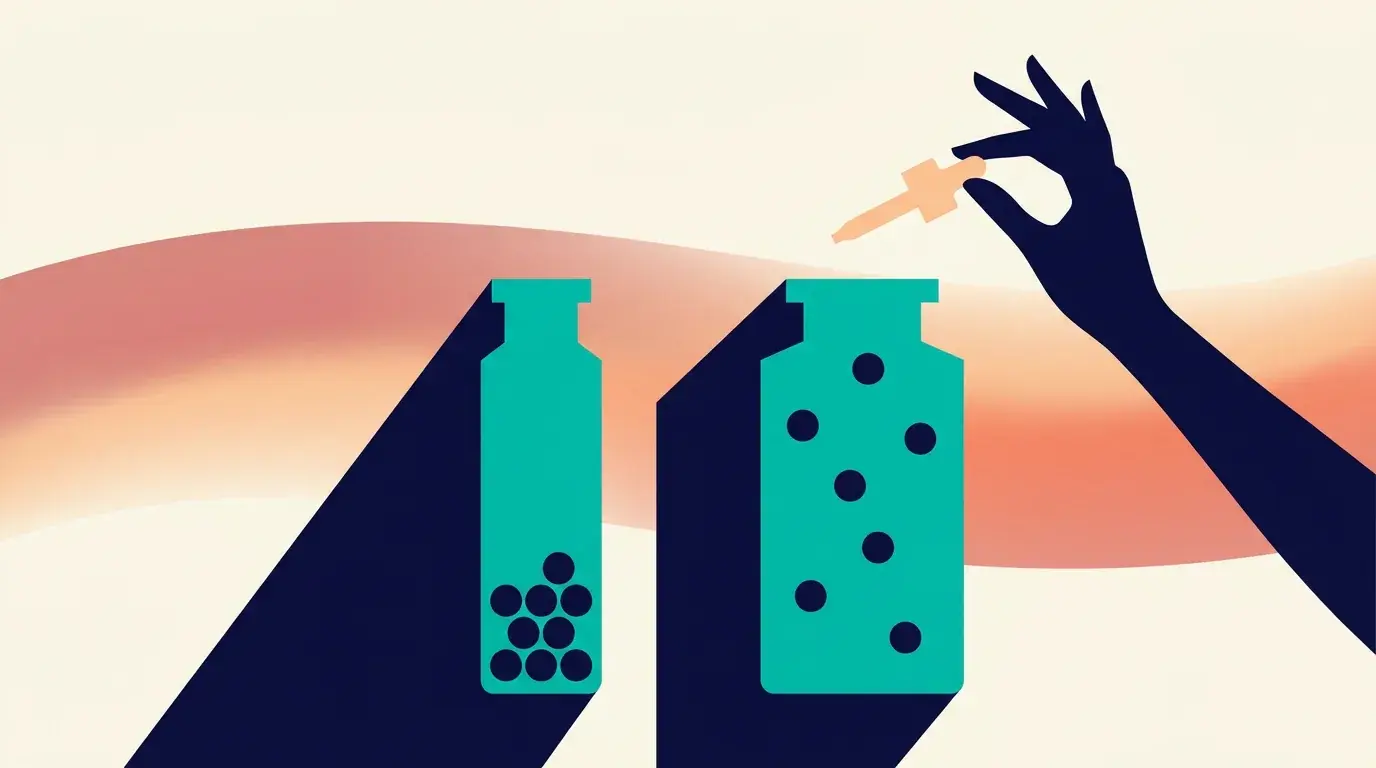
Two vials, identical contents, different diluent:
- Vial A: the drug dissolved in 1 mL → concentration X
- Vial B: identical drug dissolved in 2 mL → concentration X ÷ 2
To get the same dose out of Vial B, you draw twice the volume you would from Vial A. Same milligrams. Different number of units on the syringe.
More water is not a weaker dose. It's the same dose, spread thinner, requiring a bigger draw.
The arithmetic, step by step
Two steps.
Step 1 — Find the concentration.
mg/mL = total mg in the vial ÷ mL of diluent added
Step 2 — Convert your intended dose to syringe units.
A U-100 insulin syringe is graduated as 100 units per 1 mL. So 1 unit = 0.01 mL.
Units = (dose in mg ÷ concentration in mg/mL) × 100
A worked demonstration
The numbers below are arbitrary values chosen to demonstrate the arithmetic. They are not a dose recommendation, they are not a "typical" amount, and they should not be read as either.
Suppose a vial states 5 mg and you add 2 mL of diluent:
- Concentration: 5 ÷ 2 = 2.5 mg/mL
- For an arbitrary 0.5 mg: 0.5 ÷ 2.5 = 0.2 mL → 0.2 × 100 = 20 units
Now the same vial with 5 mL of diluent instead:
- Concentration: 5 ÷ 5 = 1 mg/mL
- Same arbitrary 0.5 mg: 0.5 ÷ 1 = 0.5 mL → 0.5 × 100 = 50 units
Same vial. Same intended milligrams. 20 units versus 50 units. That's the concentration principle made concrete, and it's why a unit number is meaningless without the concentration attached to it.
Tiro's retatrutide dose calculator performs both steps and shows its working. The reverse dose calculator runs it backwards — units and concentration in, milligrams out — which is the check to do before injecting, not after.
Four ways this maths goes wrong
1. Confusing units with milligrams. The most dangerous error in the whole category. "Units" measure volume on a syringe; milligrams measure drug. They are not related by any fixed ratio — the relationship depends entirely on concentration. Someone saying "I take 20 units" has told you nothing without their concentration. If you copy their number with a different concentration, you take a different dose.
2. Reading total mg as mg/mL. The vial states total content. If you treat "5 mg" as "5 mg/mL" and reconstitute in 2 mL, every subsequent calculation is off by a factor of two. Always derive the concentration; never assume it.
3. Changing the diluent volume and reusing old numbers. You reconstitute a new vial with a different amount of water and draw the unit number you've used for weeks. Everything about that draw is now wrong. This is the same failure mode that affects compounded GLP-1 users switching vial strengths — we cover it in switching vial concentrations, and the arithmetic is identical.
4. Trusting the label at all. The three errors above are yours to prevent. This one isn't. If the vial contains a different amount than stated — or a different substance — flawless arithmetic produces a precisely calculated wrong dose. This is the failure mode that no calculator, including ours, can detect, and it's the reason the risk here is categorically different from the risk with a prescribed medication.
"Reta pens" and why there isn't one
Some searches ask about a retatrutide pen. There isn't an approved one, and there won't be until and unless the drug is approved and a manufacturer produces a device for it.
Anything described as a "reta pen" is a repackaged or compounded presentation carrying every verification problem described above, plus a device whose dose accuracy hasn't been validated for that contents. The engineering that makes an approved autoinjector reliable — tested dose accuracy, quality-controlled fill, regulated labelling — is precisely what's absent.
For how approved pens work by contrast, see Zepbound and Mounjaro pen clicks.
What is still unknown
The trial results are genuinely striking. That is not the same as the picture being complete.
Long-term safety. The longest data runs to around two years in controlled populations. Chronic weight management is measured in decades.
The glucagon arm. Triple agonism is new, and the glucagon component is what distinguishes retatrutide from approved drugs. Trial reporting has described effects on heart rate and on hepatic measures that differ from GLP-1-only agents. This is exactly the sort of thing that supervised trials monitor for and that unsupervised use does not.
Interactions. The interaction profile with other medications and conditions has not been characterised the way an approved drug's has.
Discontinuation. Whether regain after stopping resembles the pattern seen with semaglutide and tirzepatide is not established. See rebound weight gain after stopping for what's known about the approved drugs.
Who shouldn't take it. For approved medications, contraindications are established through trials and post-marketing surveillance and printed on a label. For retatrutide there is no such label, which means there is no authoritative list of who should avoid it.
The lower-risk route
It would be dishonest to write all of the above and not say the obvious thing.
Approved semaglutide and tirzepatide, prescribed and monitored by a clinician, are the lower-risk option. Verified contents, established dosing, a known safety profile, someone accountable if something goes wrong, and no arithmetic on an unverified vial. They are also, on current evidence, highly effective — the GLP-1 dose chart shows what each currently offers, including the Wegovy HD 7.2 mg dose approved in March 2026.
We're aware that cost and access are why many people end up here rather than there, and we're not going to pretend a paragraph solves that. But the trade-off should be made with clear eyes, and most pages covering this topic have a commercial interest in you not seeing it clearly.
If you're using an approved medication: semaglutide calculator · tirzepatide calculator · dosage plotter
Frequently asked questions
Is retatrutide FDA approved? No. As of July 2026 it is investigational and not approved by the FDA, EMA or MHRA for any use. No pharmacy legally dispenses it for weight loss.
Does adding more bacteriostatic water lower my dose? No. The vial holds a fixed amount of drug. More diluent lowers the concentration, so you draw more units for the same milligrams. The dose is unchanged.
How do I convert mg to units on a U-100 syringe? Divide vial mg by diluent mL to get mg/mL, then units = (mg ÷ mg/mL) × 100, because 1 unit = 0.01 mL.
What dose of retatrutide should I take? We can't tell you, and no honest source can. There is no approved dose. Trial doses were given under supervision with monitoring; this article is arithmetic only.
Is bacteriostatic water the same as sterile water? No — bacteriostatic water contains a preservative (typically benzyl alcohol) permitting multiple withdrawals; sterile water does not. Follow the diluent's own labelling.
Can Tiro track retatrutide? Tiro logs injections, sites, symptoms and body composition for whatever you record. It does not supply, recommend or verify any medication.
Run the reconstitution maths → · Check units back to mg →
Tiro is a tracker and companion app. It is not a treatment, does not diagnose, does not supply or endorse any medication, and does not replace your prescriber. Retatrutide is not approved for use.
Track it in Tiro
Stop reading about it. Start tracking it.
Tiro turns the advice in this article into a tracked routine — your dose schedule, protein floor, symptoms, and body composition, all in one place.