What Happens When You Overeat on a GLP-1 (And What to Do Next)
Why a big meal on a GLP-1 hits harder than it used to, how long the discomfort lasts, whether it undoes your progress, and the symptoms that mean you should call.
✓Medically reviewed by Farnia Bahari, PharmD
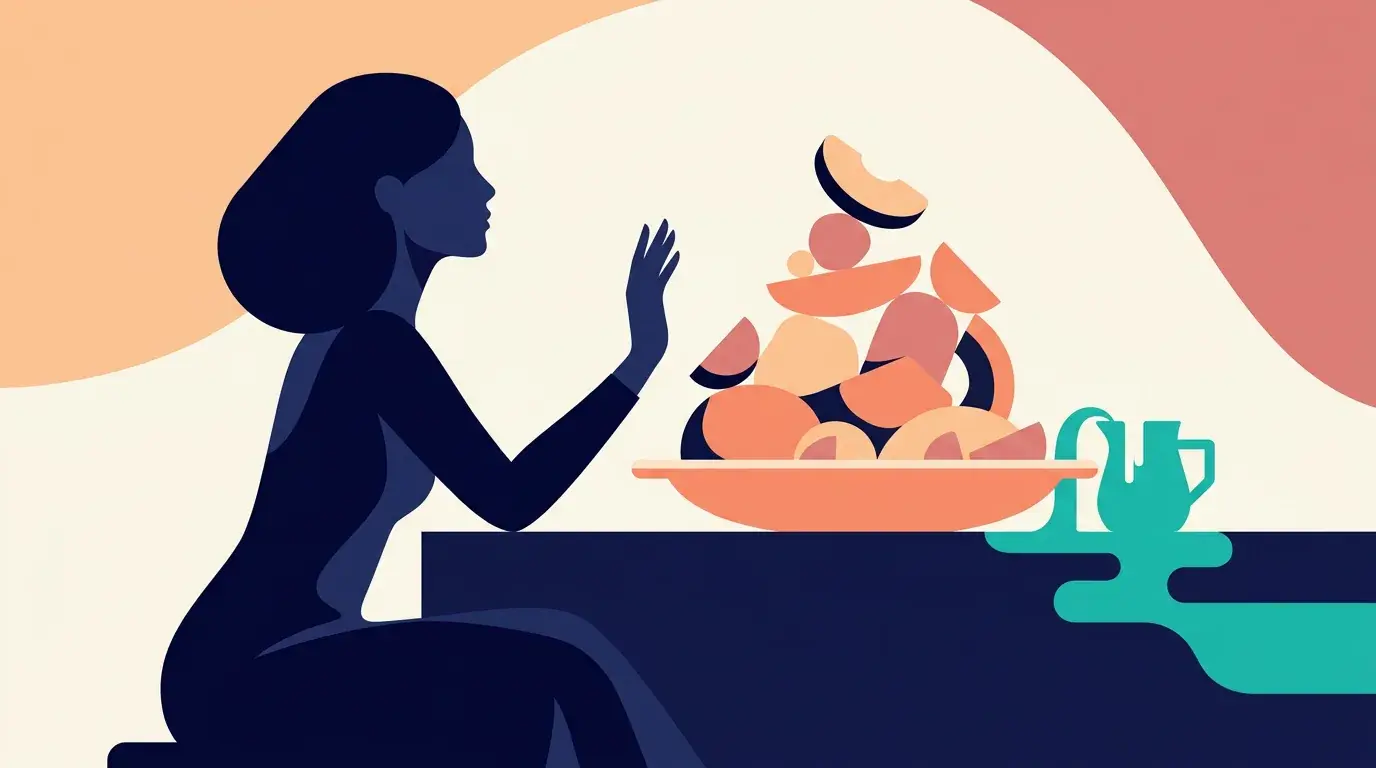
If you've just eaten a big meal on a GLP-1 and feel genuinely awful, here's what's happening: the medication slows how quickly your stomach empties, so the food has nowhere to go. A portion that would once have cleared in a couple of hours now sits there, stretching a stomach that's signalling fullness far more loudly than it used to.
The result is intense pressure, nausea, bloating, reflux and abdominal discomfort — often starting within about 30 minutes and lasting for hours. It's unpleasant, it's common, and it's not a sign you've broken anything.
Why it hits so much harder than it used to
Delayed gastric emptying is one of the mechanisms by which these medications work. It's not a side effect that happens alongside the appetite suppression — it's part of the same thing. Food stays in the stomach longer, you feel full sooner, and you feel full for longer.
The trade-off is that your stomach's tolerance for volume has dropped while its capacity to clear volume has also dropped. Exceed it and you get the full experience:
What you feel | What's causing it |
|---|---|
Overwhelming fullness, "food stuck" | Stomach contents not moving on |
Nausea, sometimes within 30 minutes | Stretch plus slowed transit |
Bloating and visible distension | Volume and gas with delayed clearance |
Reflux, burping, sour taste | Pressure pushing contents upward |
Cramping or dull ache | Stretched stomach wall |
Vomiting | The body's route of last resort |
Exhaustion afterwards | The whole episode, plus blood sugar swings |
Fat makes it worse, independently of volume. Fatty meals slow gastric emptying on their own, so a high-fat large meal compounds the effect twice over. A rich restaurant meal is the classic trigger — and often the one where saying no is hardest.
What actually helps in the moment
Nothing makes your stomach empty faster. What follows reduces pressure and makes the wait tolerable.
Do:
- Stay upright. Sitting or standing for at least a couple of hours uses gravity and reduces reflux. Lying down is the single worst thing you can do.
- Walk gently. A slow walk can ease bloating. Not a workout.
- Sip fluids slowly. Small amounts of water. Gulping adds volume to a stomach that has none to spare.
- Loosen tight clothing. Practical, and it genuinely helps.
- Wait it out. Most episodes resolve over a few hours.
Don't:
- Don't lie flat, particularly within a couple of hours.
- Don't eat more to "settle" it.
- Don't drink alcohol, which worsens both nausea and reflux.
- Don't make yourself vomit.
- Don't take antacids or anti-nausea medication without checking with your pharmacist first — some interact with slowed gastric emptying in ways that aren't helpful.
- Don't skip or delay your next dose. More on this below.
No, you haven't ruined anything
Worth saying plainly, because this is what people are actually worried about at 11pm.
One large meal does not undo weeks of weight loss. Body fat doesn't work on that timescale. The scale may well be up a pound or three the next morning — that's the physical weight of undigested food plus fluid retention from sodium and carbohydrate, and it resolves within a few days.
It doesn't stop the medication working. Semaglutide and tirzepatide have half-lives of roughly a week and five days respectively. Your levels are essentially unchanged by what you ate. The drug is still doing exactly what it was doing yesterday.
And it isn't a moral event. A lot of the content on this topic frames overeating on a GLP-1 as a discipline failure. It usually isn't — see the next section.
Why it happened, if the medication suppresses appetite
Three explanations cover most cases, and none of them is willpower.
1. Fullness signals now arrive late. The medication changes when you feel full, not only whether. Eating at your old speed means finishing the plate before the signal lands. Ten minutes later you're not full — you're overfull. Eating slowly is the single most effective countermeasure, and it's the least intuitive.
2. You ate to an occasion, not to hunger. Holidays, restaurants, family meals, work events. The plate arrives, the portion is standard, the social script says finish it. Your appetite isn't part of that negotiation.
3. You were in a trough. Appetite often returns in the last day or two before the next injection, when drug concentration is lowest — the pattern described in when appetite suppression kicks in. Meals in that window can feel much more like they used to, which is exactly when portions drift.
If it's happening repeatedly rather than occasionally, that third possibility is worth logging: a pattern clustered on days six and seven is information, and it's the kind that changes a prescriber conversation. Whether it's a genuine trough or something else is the distinction we draw in food noise coming back.
Preventing the next one
- Eat slowly and stop early. Give fullness 20 minutes to catch up. Aim to finish before you feel done.
- Protein first. It's satiating and it protects your intake target when you can only manage a small amount — see how much protein per meal.
- Watch the fat, especially at large meals.
- Pre-plan restaurant meals. Box half before you start, or order a starter as a main.
- Don't arrive starving. A small protein snack beforehand takes the edge off.
- Know your week. If day seven is consistently harder, put the big social meal earlier in your cycle.
When it's more than a bad night
Most episodes are self-limiting. Some aren't, and the difference matters.
Seek medical attention for:
- Severe or persistent abdominal pain, particularly radiating through to the back — this can indicate pancreatitis and needs assessment rather than waiting
- Repeated vomiting, or inability to keep fluids down
- Vomiting food eaten many hours or a day earlier — a possible sign of significantly delayed gastric emptying
- Signs of dehydration: dizziness, very dark urine, passing little urine, confusion
- Symptoms that don't settle over many hours, or that keep recurring after ordinary meals
- Any severe symptom that frightens you
That last category is not a cop-out. Severe upper abdominal pain after eating has several possible causes on these medications, some of which need same-day assessment. It is always reasonable to call.
One more time on dosing: don't skip, delay, double or otherwise adjust a dose because of a meal. Whatever you ate, the prescribed schedule stands unless your prescriber says otherwise. If you're unsure what to do after a disrupted week, the missed dose guide covers the general principles.
The next few days
Return to your normal pattern at the next meal. Not the next day — the next meal. The instinct to fast until dinner to "make up for it" tends to produce a second oversized meal driven by genuine hunger, which is how one bad evening becomes a bad week.
Keep protein up. It's the intake most likely to slip when appetite is disrupted, and the one that matters most for preserving muscle.
Drink. Large meals, especially salty ones, pull fluid around. Being on a GLP-1 already tilts toward drinking too little.
Stay off the scale for two or three days if a temporary rise will derail you. It's food and water, and it resolves.
Don't add restriction as a penalty. Under-eating for days after over-eating for one evening is the pattern that turns an isolated event into a cycle.
When it's a pattern rather than an evening
Everything above assumes an occasional large meal. Some things point somewhere different, and deserve saying plainly.
If you're experiencing episodes of eating a large amount with a sense of loss of control, feeling distress or shame afterwards, eating secretly, or compensating by restricting, vomiting, over-exercising or skipping doses — that's a different situation from a heavy dinner, and it's a common and treatable one.
Skipping or reducing GLP-1 doses to compensate for eating deserves particular attention. It's an understandable impulse and it's a route into a genuinely harmful pattern, as well as being unsafe on a medication with a scheduled titration.
Disordered eating is more prevalent among people seeking weight treatment than is often acknowledged, and effective help exists. If any of the above lands, it's worth raising with your prescriber, a dietitian, or an eating disorder support service. It is a clinical issue, not a discipline one.
Planning for events you can't avoid
Holidays, restaurants and family occasions are the recurring trigger. A few things that work:
Time your injection deliberately. If side effects peak on days 2–5 and appetite is lowest early in the cycle, an event on day six or seven is a different experience from one on day two. Some people plan the shot around the calendar rather than the reverse — a conversation to have with your prescriber rather than a change to make unilaterally.
Eat beforehand. A small protein snack means the first course isn't landing on an empty stomach with a fortnight of appetite behind it.
Order for your current stomach. A starter as a main, or half boxed before you begin.
Front-load the protein. If you're only going to manage a small volume, make it count.
Go easy on fat and alcohol, the two most reliable aggravators.
Have an exit line. "I'm on a medication that limits how much I can eat" ends the conversation without a debate. You don't owe anyone the details.
Frequently asked questions
What happens if you overeat on Ozempic? Slowed gastric emptying means the meal sits far longer than it used to — intense fullness, nausea, bloating, reflux and discomfort, often within 30 minutes and lasting hours.
How long does it last? Usually several hours, sometimes into the next day after a large or fatty meal. It normally settles on its own.
Does it ruin your progress? No. A single meal doesn't undo weeks of loss. A brief rise on the scale is food volume and fluid, not fat.
Should I skip my next dose? No. Keep to your prescribed schedule and talk to your prescriber if you're worried.
Why did I overeat at all? Fullness signals arrive later than they used to, occasions override appetite, and the pre-injection trough is when portions drift. It's timing, not willpower.
When should I call someone? Severe or persistent abdominal pain especially radiating to the back, repeated vomiting, inability to keep fluids down, vomiting old food, or dehydration signs.
Spot the pattern before the next big meal
Plot your levels → · Find your protein floor → · All Tiro GLP-1 tools →
Tiro is a tracker and companion app. It is not a treatment, does not diagnose, does not reduce side effects, and does not replace your prescriber.
Track it in Tiro
Stop reading about it. Start tracking it.
Tiro turns the advice in this article into a tracked routine — your dose schedule, protein floor, symptoms, and body composition, all in one place.
Keep reading
All articles →
GLP-1 Diarrhoea: What to Eat, What to Stop, and When to Call
What to eat when a GLP-1 gives you diarrhoea, the fibre mistake that backfires, the hidden ingredient in protein bars that causes it, and the dehydration red flags.
Read article →

Why Your Ozempic Injection Site Bruises (And When It Isn't a Bruise)
Bruising after a GLP-1 shot is a needle problem, not a drug problem. What causes it, the technique fixes that work, and when it needs a call.
Read article →

Mounjaro and Hair Loss: The Protein Connection Nobody Tracks (And How to Fix It)
Why Mounjaro can trigger hair shedding — and how hitting your daily protein floor (~1.2-1.6 g/kg) is the lever. Dermatology-sourced, UK-focused.
Read article →